Showing posts with label family fun. Show all posts

Tuesday, April 24, 2012

How puzzling is that? – How puzzles can rock your child’s world


Alphabet wooden puzzle
I’ve never taken a liking or interest for puzzles or chess, or any thinking games. No one has ever told me that I should, or showed to me that puzzles are fun, or has educational benefits, or can make a person smarter. From what I can see, puzzles are anything but fun. How can arranging things to make a picture seem fun? (That alone should show you how I suck at organizing and arranging stuff. Yikes.)

But that all changed when I became a parent myself. You know how a mom always wants the best for her child? I thought “I can’t let my child become a dumb-ass like me!” or somewhere along those lines. I knew that play is a child’s work, so I started researching on smart and educational play. I mean, why let them merely play, when they can play and learn and become smarter individuals at the same time? You know, kill ten birds at one time. Moms are nothing but time-saving, efficient multi-taskers.

I started exposing my kids to puzzles from they were about a year old. I bought 2-3 pieces large puzzles of animal pictures for my daughter to assemble. At first she doesn’t know how to match the head of the animals and their bodies. I’d have to show her which is the cat’s head and its body, the fish’s head and its body, and so on. But after several attempts, she seemed to catch on. She would try and match the heads and bodies and see if they fit. Then when it doesn’t, she takes another piece and tries to fit it, until she finds a perfect match. It’s amazing to see a child that young being able to match something correctly. These all happened before I started researching on the benefits of puzzles.

Physical benefits
Young children are learning and developing fine motor skills, meaning the ability to make small or fine, controlled movements. Puzzles are a fun way to improve their motor skills i.e. the ability to pinch, pick up and grasp small items which are important for writing later on. You know how babies and young toddlers are always picking up small items on the floor such as buttons, coins, dust particles and leftover foods? Yeah, that’s gross motor skills in action. Puzzles are a much cleaner and safer way to learn, don’t you think?

Another physical benefit apparent in playing with puzzles is the hand eye coordination, which involves the coordinated vision and hand movement to execute a task. We as adults may not think twice when picking up something or writing with a pen, but a young child has to learn to do this. When assembling a puzzle, the child places each piece in the puzzle and manipulating it to see if it fits. This trial and error process is also enhancing the hand eye coordination.  
Intellectual benefits
Puzzles are a way of stimulating the thinking side of a child’s brain, focusing on problem solving and reasoning skills such as process and logical thinking. As your child tries to fit and match the puzzles, they realize that there several ways to attack a problem and experiment with ways that works best for him.

Puzzles also improve a child’s cognitive skills, i.e. learning to understand how the small puzzle pieces fit together to form a complete puzzle set. Depending on the puzzle theme, they’re also learning specific subjects such as alphabets, numbers, animals and colours, among many others.

My daughter arranging puzzles on her own.
Emotional and social benefits
You know how it feels to accomplish something? How satisfying that feels? Children feel that too. You can see how absorbed and determined they are, trying to fit them together until they match. And when they finally finish the puzzle, they clap and cheer to acknowledge that sense of achievement. The accomplishment and the praise by the audience (adoring parents, of course) increase self confidence.

Puzzles are the one of the best family or social games around, just like card and board games such as Monopoly and Uno. Fitting a puzzle requires cooperation and thinking as a group, which is also a great bonding tool. As parents guide their children on matching the puzzle pieces, they could also encourage them to try again when the child gets it wrong, encourage them not to give up and think around the problem, teach them how to handle frustration. Quality time with your kids, and learning so many things at the same time. That certainly beats your child hogging your Ipad playing Angry Birds for hours.

So keeping in mind all these benefits, it’s about time that you start buying some puzzles for your kids, don’t you think? ;)

Wednesday, April 18, 2012

Alphabet Match Up activity for kids


I originally found this at Muffin Tin Mom website, and I think it’s quite simple to make, using cheap stationeries, so I decided to give it a try. I did it from scratch in about an hour or so, while the kids were taking their afternoon nap. I already bought the materials beforehand for quite a while now, but I never had the time to do it (or possibly, too lazy to think about it. Hah!).

So, laying out the materials.

A large cardboard in any colour you prefer. I chose orange to make it nice and bright.

A stack of paper. You can use normal A4 paper if you like (or if you’re more cheapskate than me), or buy some nice cardstock like I did. You can even cut up some boxes and then paste the alphabet card on it, to make a sturdier card.

A strip of Velcro, scissors and coloured pens, if you’d like to colour and decorate the cards. I didn’t have time to do any decorating as my kids woke up just as I finished.

I forgot to take photos of my own stickers. Hmmph.
2 sets of alphabet stickers. You can just print out 2 sets of alphabet flashcards from the internet, or buy some, if you like. It would save more time, as you won’t need to cut up the paper or paste stickers. Up to you, really. My kids love stickers, so I decided to buy some.

Ok, let’s start!

This is the fast and easy way to cut up the paper. (I’m racing against time here, remember?) Fold the paper in two and cut it up. Then fold the long strip of paper into four and cut them up. One sheet of paper can produce 8 little cards, just about the size of a flashcard. You don’t want it to be too big, it’ll take up too much space on the cardboard.

As there are 26 alphabets, you’ll need 52 little cards in total. (Did you have to count how many letters are there? Heh.)

Here’s the fun part – pasting the stickers on the cards. Go ahead, it’ll bring out the child in you, I promise! And you’ll understand why kids love stickers so much.

I have no idea why this picture came out vertical like this.  Can someone tell me how to fix this?
Before you start sticking the Velcro on the cards and on the cardboard, I think it’s better to arrange the cards on the cardboard first, just to be sure of the placing. Good thing I did, I couldn’t fit all the letters on one surface, so I had to continue on the back. As you can see from the Muffin Tin Mom, her cardboard is bigger so it could fit all the letters. Or maybe my arrangement is a little off, I don’t know. It’s okay, we’re not trying to be too precise, it’s an activity for kids anyway. Unless you or your kids have OCD.

Then cut up the Velcro strip into small pieces. For people who have never used Velcro before, (like yours truly) you might wonder why there are two strips. One strip is the hairy one and the other is the rough one. They only stick on each other i.e. if you try to stick the hairy piece onto another hairy piece, it won’t stick. So you need to stick the rough ones on the large cardboard and the hairy ones on the back of each little card.

Okay, go ahead and stick them all.


Like I said, I had to continue on the back.

Unlike the Muffin Tin Mom, I forgot to make the small open box the put in the second set of cards. Oh well.

All done!

That wasn’t too hard, was it? ;)

Tuesday, March 13, 2012

Personally, I've never read any of his books. Only today that I realized that The Grinch and Horton the Elephant are characters from his books. I guess with the launch of the new movie 'The Lorax' (what the hell is that??) and his recent birthday, March 2, that I begin to get the "Seuss" awareness.

But I'd like to share this image I found here with his famous quotes, which are really fun to say. They're like tongue twisters!

And check out his official website, Seussville. It's like a fantasy playland, where everything's waving and playing merrily.


Thursday, June 16, 2011

BENEFITS OF A PLAYGROUP

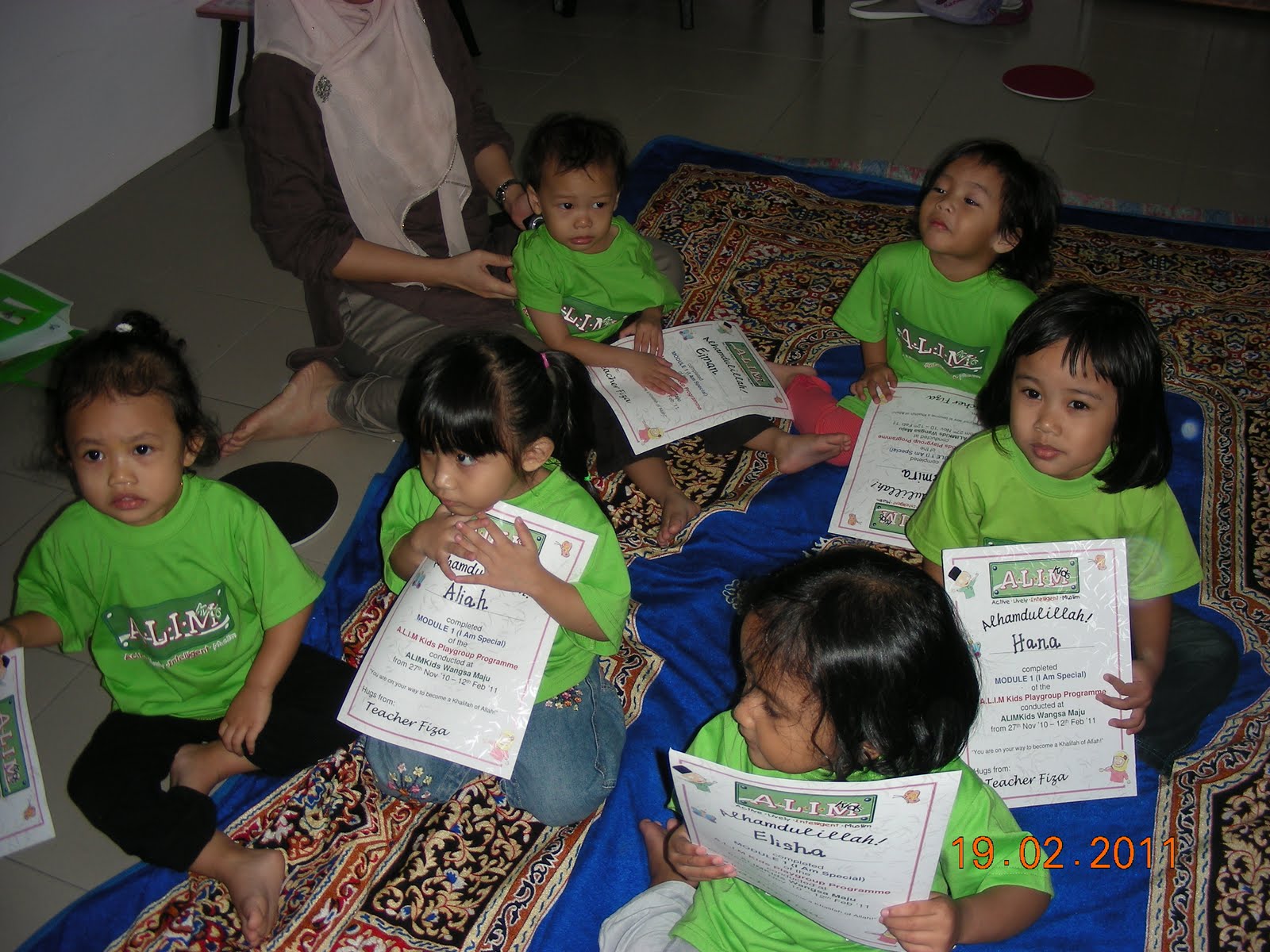
I’ve been sending my 3 year old daughter, Aliah to a nearby playgroup, ALIMKids, for about 6 months now. The playgroup is held on Saturday mornings, perfect for working parents like me. Despite the belief that playgroups are for stay-at-home parents to be able to get together with other parents with their children in tow, my ultimate reason of sending my daughter to a playgroup is for her to socialize with other kids her age. As she stays at home with her little brother and my maid all week long, I thought it would be good for her social skills, besides the fun things she could do and learn at the playgroup.

As my kids age gap are quite close (their birthdays are 20 months apart), the sibling rivalry is pretty intense i.e. a lot of fighting and bickering and pushing, and of course, bawling. The playgroup actually teaches my daughter to share things, take turns at doing something and learn some manners and the appropriate behavior with her friends. In turn, she teaches her little brother how to share. It’s really funny to see them ‘sharing’ a toy; they weren’t even playing, they just keep passing the toy back and forth to each other!

As a working parent, I have to admit, it’s difficult to find time to do activities with your kids by yourself. Just imagining myself sitting with them, painting and scribbling, gives me a headache. Because they definitely won’t sit down quietly; they’ll bicker over the crayons or paints, or even worse, run around the house and mess up the walls, sofas and the tv! A child may not be allowed to use scissors or make messes at home, but painting, scribbling, cutting, gluing and messes are definitely encouraged at playgroups.

Activities like these are best supervised by parents, but knowing the busy moms nowadays, who would have the time to play all day when you have cleaning and cooking and laundry to do? At playgroups, the playtime is somewhat structured; you sing first, then do some crafts, then you put away the crafts and do some physical play, then finally a group reading. When it’s time for the next activity, the children would clean up to get ready for the next task. For example, when a child wants to keep on colouring, she sees her friends cleaning up and gathering around the teacher to read a book, she quickly cleans up too, not wanting to be left behind. It’s like the children are automatically conscious of their peers, making them want to blend in, do the same things together, conform to each other and work as a team.

It’s kinda funny, but I myself look forward to these Saturday playgroups, which means exclusive bonding time spent with my daughter. This exclusive time is pretty scarce, as both my kids are endlessly fighting for my attention (sounds flattering, I know. But believe me, it’s a lot of headache.). It’s nice to be able to focus on her alone, see her play and sing and scribble. This one hour is also like a break for me from things, stuff, tasks – to do at home.

Here are some of the activities they do at the playgroup, which are mostly group reading, craft play, alphabets, singing and some physical play.

Group reading


Singing and dancing with body movements

Messy crafts such as finger painting

Playhouse


Even birthday celebrations

Making music

Lots and lots of colouring

Ribbon play

A special activity done by ALIMKids – Parachute play

The truth is, I’ve never seen a parachute play before encountering this playgroup. So I feel that it’s worth a brief explanation in itself.

Benefits of Parachute Play

  • Encourages cooperation, teamwork and creates a group awareness
  • Non-competitive - Differing abilities and even differing ages are non-issue. It focuses on playing, not winning
  • Refines perceptual skills - Reinforces turn-taking/ sharing
  • Develops a sense of rhythm - Requires following directions
  • Promotes social interaction - Enhances language development
  • Delightful imaginative play – encouraging role play such as pirates, princess or treasure hunter

Sources:

www.squidoo.com,

www.childcarelounge.com

Finally, graduation!

I highly recommend enrolling your kids to a playgroup like this. It’s a fun and great social environment plus informal learning for your child. It’s also a great bonding experience for you and your child. What’s not to love?

Wednesday, February 9, 2011

Water Babies - Toddler update

When teaching your toddler to swim, the 3 most basic things to teach would be:
  • Blowing bubbles
  • Going underwater
  • Floating

Blowing bubbles

When you teach your child to blow bubbles, you’re actually teaching him to blow out the breath while underwater, which is the proper form while actually swimming. People who have never joined a real swimming lesson would say, swim a breaststroke, while holding the breath while being underwater and blow out the breath when the head breaks the water surface (like myself, before I joined a swimming class. See, even a clueless adult can get this wrong). It’s actually the reverse; you take a deep breath, dip your head into the water and blow out your breath in bubbles while underwater.

Firstly, teach your toddler to blow soap bubbles, which is great fun!

Photo courtesy of www.earthhopenetwork.net

Once he’s got the hang of it, you can try and get his face close to the water and blow something across the water, say a boat or a rubber duckie. When he’s comfortable enough, you can show him to blow bubbles underwater. You can demonstrate by taking a deep breath, put the lower half of your face into the water and blow out bubbles.

Photo courtesy of www.iswimemler.com

These gradual steps ease the fear and pressure off your child, while increasing his confidence with water. Most children love to play with water, by getting your head underwater is whole different story.

Going underwater

There are basically 2 ways to go underwater, by holding your breath or by blowing out your breath (duh). In my opinion, blowing out is easier for a child than holding the breath. Some kids simply do not understand how to hold the breath! It’s better if you can make a game out of it, say holding your breath and blow out three candles at once. Or using the earlier example, hold your breath and blow a rubber duckie as far as you can across the pool.

Once he can do this, then you can teach him to hold the breath, while you pour water over his face. Another way is to hold the breath before you pour the water, and blowing out when you actually pour the water. When he masters this, then you can proceed to telling him to hold his breath, and gently dipping him in the water.

Holding the breath is one of the most basic skills needed when one learns to swim. If you have ever enrolled yourself in a swimming lesson or you’ve tried swimming on your own, the first thing you do to swim is hold your breath, head underwater, arms up and straight in front of your head and kick your legs. Teaching your toddler to hold his breath is a preparation for this, sparing him the unfortunate swallowing or inhaling water through the nose or mouth, which can be very painful and traumatic. It could even scare your child off from trying to hold his breath again.

Floating

A basic back float can be a life saver if a child accidentally falls into a pool or a lake. The key to floating on your back is to relax. Fear and panic will definitely bring him down into the water. This is why teaching a baby to float is much easier, because babies are more relaxed and feels comfortable in water, due to their previous water-like surroundings in the mother’s womb.

To ease this fear, you could help your child to float by laying him gently on his back in the pool, with his head resting on your shoulder, one of your hands on his back in the water and your other hand on his chest to make him feel more secure. When he’s confident enough in this position, you could move your hand from his chest and support the back of his head. When he’s relaxed enough, gently let go of your hands.

Okay, time to take a picture!


“Going down to the pool” has become a weekly activity for my kids. Both of them had not started swimming yet, but they certainly enjoy just being in the pool, splashing each other and play ball. My daughter, while wearing arm floats, has started floating on her back, which she practically learned on her own. I was watching my boy when my husband, who was taking photos from the side, called out. I turned around and saw her floating on her own. She has yet to learn to go without the float, though.

And there's my little boy.

Just for fun, watch these videos of my kids in the pool. Sorry about the video quality, it was taken from my 2 MP old camera phone. And please excuse yours truly yelling in the background. A mom just gets too excited sometimes. Heh.


References:

www.suite101.com, www.swimming-techniques-learn.com

Wednesday, November 24, 2010

Giveaway time!

I mentioned in my last post that there would be a giveaway for all readers.

I’m giving away an e-book entitled Alphabet of Birds. All you have to do is link up with me at the bottom of this post, and I’ll email you a copy. It’s just a token of appreciation for you guys out there!

This fully illustrated e-book teaches multiple things in a mere 18 pages.

It teaches the alphabet. It teaches association of each letter to a specific species of bird. The best part is the rhyming description of the bird, which makes it more fun to recite and easier to remember.

I used to take Arabic language lessons when I was younger, where remembering the grammar was certainly a mouthful for 9 year-old kid. So the teacher made a rhyming song for it, making it easier for us to remember. During exams, you could hear a low buzzing of voices gently singing the song while answering questions.

Here’s a sampling of the Alphabet of Birds.

I didn’t know half of the birds in here myself! (Ermm does that mean I’m a bad mom? I hope not.)

Have fun reading and singing and learning!


Wednesday, October 6, 2010

Travel toys for babies and toddlers

We’re going to Penang this weekend for a family gathering.

Photo courtesy of http://www.malaysia-holidays-4u.com/

It’s about a 5-hour drive from KL to Penang, so I was thinking of buying a new toy for each of child to engross them in the car, so I can relax a little a bit without having one of them climbing on my back (the baby) and the other cuddling like a baby in my arms (the big sister).

I was thinking of toys like these for the baby.

Lamaze: Jacque The Peacock

Taf Toys: Infant Car Toy

Taf Toys: Curiosity Cube

For the big sister.

Read & Play: Dress Up Bear Book

Baby Einstein: 365 Days of Baby Einstein Book

Baby Einstein: Pretty Poems and Wonderful Words Lift the Flap Book

All toys from www.mybbstore.com.

If's money is not a problem, I would have bought all of them. But as it is, I'm not a millionaire mom.

Any suggestions, anyone?

Wednesday, August 5, 2009

Let's go vacationing!

Courtesy of www.holidaybabykw.com

Our little family will be going to Langkawi by flight on a 3 days and 2 nights trip, together with my in-laws. Aliah is quite used to car travel, but this will be her first time boarding an airplane, so I am somewhat apprehensive. So I’m writing this to serve as a checklist on my own.

Things to put in her diaper bag
  • 3 or 4 spare diapers
  • a waterproof changing surface – it’s included in the bag, anyway
  • at least 2 pairs of clean clothes. Aliah perspires a lot. And she might decide to do a poop job.
  • Wet wipes
  • formula dispenser filled with formula (obviously) enough for 3 or 4 feedings. So if the family decides to go shopping right after we check into the hotel, I won’t have to dig into the bag to fill in the dispenser.
  • at least 2 clean bottles, just in case she wants a feed en route
  • 1 ready to drink formula, just in case she wants a feed immediately
  • 1 full bottle of warm water – she loves water, by the way
  • A thermos flask. I’m not sure whether we’re allowed to bring liquids through the security gates, but if not, I’ll just throw out the water then.
  • A bib
  • Her travel fork & spoon
  • Several plastic bags for diaper changes or soiled clothes. I love this Diaper Duck Travel Buddy sold at www.mybbstore.com, if you don’t mind spending RM30 on disposable plastic bags. It’s so cute! But I’ll just stick to the free plastic bags for now.
  • Some snacks – biscuits, sandwiches or maybe some fruit
  • A toy or two. As she loves to scribble and I prefer not to worry about missing pencils, I bought a small Fisher-Price Doodle Pro that comes with a clip. And maybe I’ll bring her favourite Count and Play book.

Things to put in her own suitcase

Aliah is currently undergoing treatments to cure her newly contracted asthma. So I’m gonna have to bring all her medications, along with some other stuff such as

  • A thermometer
  • Baby paracetemol
  • One of her cold/cough meds, just in case
  • Diaper rash ointment. She rarely gets diaper rash, but it’s better to be prepared.

All the other stuff is regular things such as

  • Enough change of day clothes and night clothes. She still vomits every once in a while especially at night, so it never hurt s to bring extra clothes.
  • Her toiletries, compact size – baby head-to-toe wash, baby powder, toothbrush, her hairbrush and little scrunchie (her hair are so long, they’re getting into her eyes)
  • Socks and Vicks vapor rub, for night use. It eases her night coughing.
  • One or two of her favourite pillows
  • Her blanket, even though she hates it. She usually kicks it off madly when I cover her up.
  • Her formula and extra bottles
  • Bottle brush for bottle washing
  • Antibacterial hand gel
  • More diapers and wet wipes
  • Shoes and her newly bought sunglasses. I just can’t resist, they’re so cute!
  • Her ever useful stroller
  • Don’t forget the camera!

Have I forgotten anything important here? Hope not. Please let me know it I did.
So I think we’re ready for this vacation. Langkawi, here we come!

Related Posts with Thumbnails